The sections below give objective criteria for evaluating the usability of machine translation software output. == Stationarity or canonical form == Do repeated translations converge on a single expression in both languages? I.e. does the translation method show stationarity or produce a canonical form? Does the translation become stationary without losing the original meaning? This metric has been criticized as not being well correlated with BLEU (BiLingual Evaluation Understudy) scores. == Adaptive to colloquialism, argot or slang == Is the system adaptive to colloquialism, argot or slang? The French language has many rules for creating words in the speech and writing of popular culture. Two such rules are: (a) The reverse spelling of words such as femme to meuf. (This is called verlan.) (b) The attachment of the suffix -ard to a noun or verb to form a proper noun. For example, the noun faluche means "student hat". The word faluchard formed from faluche colloquially can mean, depending on context, "a group of students", "a gathering of students" and "behavior typical of a student". The Google translator as of 28 December 2006 doesn't derive the constructed words as for example from rule (b), as shown here: Il y a une chorale falucharde mercredi, venez nombreux, les faluchards chantent des paillardes! ==> There is a choral society falucharde Wednesday, come many, the faluchards sing loose-living women! French argot has three levels of usage: familier or friendly, acceptable among friends, family and peers but not at work grossier or swear words, acceptable among friends and peers but not at work or in family verlan or ghetto slang, acceptable among lower classes but not among middle or upper classes The United States National Institute of Standards and Technology conducts annual evaluations [1] Archived 2009-03-22 at the Wayback Machine of machine translation systems based on the BLEU-4 criterion [2]. A combined method called IQmt which incorporates BLEU and additional metrics NIST, GTM, ROUGE and METEOR has been implemented by Gimenez and Amigo [3]. == Well-formed output == Is the output grammatical or well-formed in the target language? Using an interlingua should be helpful in this regard, because with a fixed interlingua one should be able to write a grammatical mapping to the target language from the interlingua. Consider the following Arabic language input and English language translation result from the Google translator as of 27 December 2006 [4]. This Google translator output doesn't parse using a reasonable English grammar: وعن حوادث التدافع عند شعيرة رمي الجمرات -التي كثيرا ما يسقط فيها العديد من الضحايا- أشار الأمير نايف إلى إدخال "تحسينات كثيرة في جسر الجمرات ستمنع بإذن الله حدوث أي تزاحم". ==> And incidents at the push Carbuncles-throwing ritual, which often fall where many of the victims - Prince Nayef pointed to the introduction of "many improvements in bridge Carbuncles God would stop the occurrence of any competing." == Semantics preservation == Do repeated re-translations preserve the semantics of the original sentence? For example, consider the following English input passed multiple times into and out of French using the Google translator as of 27 December 2006: Better a day earlier than a day late. ==> Améliorer un jour plus tôt qu'un jour tard. ==> To improve one day earlier than a day late. ==> Pour améliorer un jour plus tôt qu'un jour tard. ==> To improve one day earlier than a day late. As noted above and in, this kind of round-trip translation is a very unreliable method of evaluation. == Trustworthiness and security == An interesting peculiarity of Google Translate as of 24 January 2008 (corrected as of 25 January 2008) is the following result when translating from English to Spanish, which shows an embedded joke in the English-Spanish dictionary which has some added poignancy given recent events: Heath Ledger is dead ==> Tom Cruise está muerto This raises the issue of trustworthiness when relying on a machine translation system embedded in a Life-critical system in which the translation system has input to a Safety Critical Decision Making process. Conjointly it raises the issue of whether in a given use the software of the machine translation system is safe from hackers. It is not known whether this feature of Google Translate was the result of a joke/hack or perhaps an unintended consequence of the use of a method such as statistical machine translation. Reporters from CNET Networks asked Google for an explanation on January 24, 2008; Google said only that it was an "internal issue with Google Translate". The mistranslation was the subject of much hilarity and speculation on the Internet. If it is an unintended consequence of the use of a method such as statistical machine translation, and not a joke/hack, then this event is a demonstration of a potential source of critical unreliability in the statistical machine translation method. In human translations, in particular on the part of interpreters, selectivity on the part of the translator in performing a translation is often commented on when one of the two parties being served by the interpreter knows both languages. This leads to the issue of whether a particular translation could be considered verifiable. In this case, a converging round-trip translation would be a kind of verification.
Ciscogate
Ciscogate, also known as the Black Hat Bug, is the name given to a legal incident that occurred at the Black Hat Briefings security conference in Las Vegas, Nevada, on July 27, 2005. On the morning of the first day of the conference, July 26, 2005, some attendees noticed that 30 pages of text had been physically ripped out of the extensive conference presentation booklet the night before at the request of Cisco Systems and the CD-ROM with presentation slides was not included. It was determined the pages covered a talk to be given by Michael Lynn, a security researcher with Atlanta-based IBM Internet Security Systems (ISS). Instead of the pages with the details, attendees found a photographed copy of a notice from Black Hat saying "Due to some last minute changes beyond Black Hat's control, and at the request of the presenter, the included materials aren't up to the standards Black Hat tries to meet. Black Hat will be the first to apologize. We hope the vendors involved will follow suit." According to Lynn's lawyer, his employer had approved of the talk leading up to the conference but changed their minds two days before the scheduled talk, forbidding him from presenting. Lynn's original presentation was to cover a vulnerability in Cisco routers. The presentation was one of four scheduled to follow Jeff Moss' keynote address on the first day of the conference, titled "Cisco IOS Security Architecture". After being told by his employer that he could not present on the topic, Lynn chose an alternate topic. Cisco and ISS had offered to give new joint presentation but this was turned down by Black Hat because the original speaking slot was given to Lynn, not Cisco. Lynn's presentation began by covering security issues in services that allow users to make Voice over IP telephone calls. Shortly after beginning the presentation Lynn changed back to his original topic and began disclosing some technical details of the vulnerability he found in Cisco routers stating that he would rather resign from his job at ISS than keep the details private. == Lawsuit == Shortly after Lynn concluded his talk he met Jennifer Granick, who would soon become his lawyer. During their initial meeting Lynn told Granick that he expected to be sued. Later in the evening Lynn had heard that Cisco and ISS had filed a lawsuit and requested a temporary restraining order against Black Hat but not himself. A public relations representative from Black Hat told Granick that the lawsuit was against both Black Hat and Lynn and that the companies had scheduled an Ex parte hearing in San Francisco the next morning to request the restraining order. That night, Andrew Valentine, an attorney for ISS and Cisco called Lynn who directed them to Granick. During the conversation Valentine explained the claims and accusations against Lynn, which included three things: 1) ISS claimed copyright over the presentation that Lynn gave, 2) Cisco claimed copyright over the decompiled machine code obtained from the router which was included in the presentation, and 3) Cisco claimed the presentation contained trade secrets. These complaints were outlined in a civil complaint at the U.S. Northern District of California and filed against both Lynn and Black Hat. According to Granick, she and Valentine were able agree to an injunction to settle the case without court proceedings. This deal was almost called off due to an inadvertent mistake by Black Hat in which they had restored Lynn's presentation on their web server. Black Hat, Granick, and the plaintiff's lawyers were able to resolve this problem and the deal stood. One condition of the settlement required Lynn to provide an image of all computer data he used in his research to be provided to a third party for forensic analysis before erasing his research and any Cisco data from his systems. The settlement also stipulated that Lynn was prohibited from talking about the vulnerability in the future. == FBI Investigation == Shortly after lawyers for Lynn and ISS / Cisco filed settlement papers, FBI agents from the Las Vegas office arrived at the conference to begin asking questions. According to Granick, they were there at the request of the Atlanta FBI office and Lynn was not of interest. Granick asserted the Fifth and Sixth amendment rights on behalf of her client, Lynn. Granick asserted his rights for the Atlanta office and asked if an arrest warrant had been issued for Lynn. Over the next 24 hours Granick was not able to ascertain the status of a warrant but ultimately determined no warrant was issued. When the FBI was asked about the case by a journalist, spokesman Paul Bresson declined to discuss the case saying "Our policy is to not make any comment on anything that is ongoing. That's not to confirm that something is, because I really don't know". Granick would only confirm to journalists that the "investigation has to do with the presentation". == Response == === Attendees === Attendees of Black Hat Briefings, as well as many that also attended DEF CON, were not happy with vendors threatening legal action over vulnerability disclosure. The term "Ciscogate" was coined quickly by an unknown person, but some attendees were quick to create shirts to commemorate the incident. === Cisco === Mojgan Khalili, a senior manager for corporate PR at Cisco, issued a statement to the press saying "It is important to note that the information Mr. Lynn presented was not a disclosure of a new vulnerability or a flaw with Cisco IOS software. Mr. Lynn's research explores possible ways to expand exploitations of existing security vulnerabilities impacting routers." === ISS === Kim Duffy, managing director of ISS Australia, was asked about ISS's response to the incident. Duffy responded that it was "business as usual" as the company handled the incident "strictly by the book". He gave a brief statement to ZDNet UK saying "ISS has published rules for disclosure and that is what we stick to. We didn't care to publish [the disclosure] because we were not ready. We had not completed the research to our satisfaction so it was not ready to be disclosed". ISS spokesperson Roger Fortier confirmed that Lynn was no longer employed with the company and that ISS was still working with Cisco on the matter. He gave a statement to the Washington Post saying "ISS and Cisco have been working on this in the background and didn't feel at this time that the material was ready for publication. The decision was made on Monday to pull the presentation because we wanted to make sure the research was fully baked."
Transfer function matrix
In control system theory, and various branches of engineering, a transfer function matrix, or just transfer matrix is a generalisation of the transfer functions of single-input single-output (SISO) systems to multiple-input and multiple-output (MIMO) systems. The matrix relates the outputs of the system to its inputs. It is a particularly useful construction for linear time-invariant (LTI) systems because it can be expressed in terms of the s-plane. In some systems, especially ones consisting entirely of passive components, it can be ambiguous which variables are inputs and which are outputs. In electrical engineering, a common scheme is to gather all the voltage variables on one side and all the current variables on the other regardless of which are inputs or outputs. This results in all the elements of the transfer matrix being in units of impedance. The concept of impedance (and hence impedance matrices) has been borrowed into other energy domains by analogy, especially mechanics and acoustics. Many control systems span several different energy domains. This requires transfer matrices with elements in mixed units. This is needed both to describe transducers that make connections between domains and to describe the system as a whole. If the matrix is to properly model energy flows in the system, compatible variables must be chosen to allow this. == General == A MIMO system with m outputs and n inputs is represented by a m × n matrix. Each entry in the matrix is in the form of a transfer function relating an output to an input. For example, for a three-input, two-output system, one might write, [ y 1 y 2 ] = [ g 11 g 12 g 13 g 21 g 22 g 23 ] [ u 1 u 2 u 3 ] {\displaystyle {\begin{bmatrix}y_{1}\\y_{2}\end{bmatrix}}={\begin{bmatrix}g_{11}&g_{12}&g_{13}\\g_{21}&g_{22}&g_{23}\end{bmatrix}}{\begin{bmatrix}u_{1}\\u_{2}\\u_{3}\end{bmatrix}}} where the un are the inputs, the ym are the outputs, and the gmn are the transfer functions. This may be written more succinctly in matrix operator notation as, Y = G U {\displaystyle \mathbf {Y} =\mathbf {G} \mathbf {U} } where Y is a column vector of the outputs, G is a matrix of the transfer functions, and U is a column vector of the inputs. In many cases, the system under consideration is a linear time-invariant (LTI) system. In such cases, it is convenient to express the transfer matrix in terms of the Laplace transform (in the case of continuous time variables) or the z-transform (in the case of discrete time variables) of the variables. This may be indicated by writing, for instance, Y ( s ) = G ( s ) U ( s ) {\displaystyle \mathbf {Y} (s)=\mathbf {G} (s)\mathbf {U} (s)} which indicates that the variables and matrix are in terms of s, the complex frequency variable of the s-plane arising from Laplace transforms, rather than time. The examples in this article are all assumed to be in this form, although that is not explicitly indicated for brevity. For discrete time systems s is replaced by z from the z-transform, but this makes no difference to subsequent analysis. The matrix is particularly useful when it is a proper rational matrix, that is, all its elements are proper rational functions. In this case, the state-space representation can be applied. In systems engineering, the overall system transfer matrix G (s) is decomposed into two parts: H (s) representing the system being controlled, and C(s) representing the control system. C (s) takes as its inputs the inputs of G (s) and the outputs of H (s). The outputs of C (s) form the inputs for H (s). == Electrical systems == In electrical systems, it is often the case that the distinction between input and output variables is ambiguous. They can be either, depending on circumstance and point of view. In such cases, the concept of port (a place where energy is transferred from one system to another) can be more useful than input and output. It is customary to define two variables for each port (p): the voltage across it (Vp) and the current entering it (Ip). For instance, the transfer matrix of a two-port network can be defined as follows, [ V 1 V 2 ] = [ z 11 z 12 z 21 z 22 ] [ I 1 I 2 ] {\displaystyle {\begin{bmatrix}V_{1}\\V_{2}\end{bmatrix}}={\begin{bmatrix}z_{11}&z_{12}\\z_{21}&z_{22}\\\end{bmatrix}}{\begin{bmatrix}I_{1}\\I_{2}\end{bmatrix}}} where the zmn are called the impedance parameters, or z-parameters. They are so-called because they are in units of impedance and relate port currents to a port voltage. The z-parameters are not the only way that transfer matrices are defined for two-port networks. Six basic matrices relate voltages and currents, each with advantages for particular system network topologies. However, only two of these can be extended beyond two ports to an arbitrary number of ports. These two are the z-parameters and their inverse, the admittance parameters or y-parameters. To understand the relationship between port voltages and currents and inputs and outputs, consider the simple voltage divider circuit. If we only wish to consider the output voltage (V2) resulting from applying the input voltage (V1) then the transfer function can be expressed as, [ V 2 ] = [ R 2 R 1 + R 2 ] [ V 1 ] {\displaystyle {\begin{bmatrix}V_{2}\end{bmatrix}}={\begin{bmatrix}{\dfrac {R_{2}}{R_{1}+R_{2}}}\end{bmatrix}}{\begin{bmatrix}V_{1}\end{bmatrix}}} which can be considered the trivial case of a 1×1 transfer matrix. The expression correctly predicts the output voltage if there is no current leaving port 2, but is increasingly inaccurate as the load increases. If, however, we attempt to use the circuit in reverse, driving it with a voltage at port 2 and calculate the resulting voltage at port 1 the expression gives completely the wrong result even with no load on port 1. It predicts a greater voltage at port 1 than was applied at port 2, an impossibility with a purely resistive circuit like this one. To correctly predict the behaviour of the circuit, the currents entering or leaving the ports must also be taken into account, which is what the transfer matrix does. The impedance matrix for the voltage divider circuit is, [ V 1 V 2 ] = [ R 1 + R 2 R 2 R 2 R 2 ] [ I 1 I 2 ] {\displaystyle {\begin{bmatrix}V_{1}\\V_{2}\end{bmatrix}}={\begin{bmatrix}R_{1}+R_{2}&R_{2}\\R_{2}&R_{2}\end{bmatrix}}{\begin{bmatrix}I_{1}\\I_{2}\end{bmatrix}}} which fully describes its behaviour under all input and output conditions. At microwave frequencies, none of the transfer matrices based on port voltages and currents are convenient to use in practice. Voltage is difficult to measure directly, current next to impossible, and the open circuits and short circuits required by the measurement technique cannot be achieved with any accuracy. For waveguide implementations, circuit voltage and current are entirely meaningless. Transfer matrices using different sorts of variables are used instead. These are the powers transmitted into, and reflected from a port, which are readily measured in the transmission line technology used in distributed-element circuits in the microwave band. The most well-known and widely used of these sorts of parameters is the scattering parameters, or s-parameters. == Mechanical and other systems == The concept of impedance can be extended into the mechanical and other domains through a mechanical-electrical analogy, hence the impedance parameters and other forms of 2-port network parameters can also be extended to the mechanical domain. To do this, an effort variable and a flow variable are made analogues of voltage and current, respectively. For mechanical systems under translation these variables are force and velocity respectively. Expressing the behaviour of a mechanical component as a two-port or multi-port with a transfer matrix is a useful thing to do because, like electrical circuits, the component can often be operated in reverse and its behaviour is dependent on the loads at the inputs and outputs. For instance, a gear train is often characterised simply by its gear ratio, a SISO transfer function. However, the gearbox output shaft can be driven around to turn the input shaft, requiring a MIMO analysis. In this example, the effort and flow variables are torque T and angular velocity ω, respectively. The transfer matrix in terms of z-parameters will look like, [ T 1 T 2 ] = [ z 11 z 12 z 21 z 22 ] [ ω 1 ω 2 ] {\displaystyle {\begin{bmatrix}T_{1}\\T_{2}\end{bmatrix}}={\begin{bmatrix}z_{11}&z_{12}\\z_{21}&z_{22}\end{bmatrix}}{\begin{bmatrix}\omega _{1}\\\omega _{2}\end{bmatrix}}} However, the z-parameters are not necessarily the most convenient for characterising gear trains. A gear train is the analogue of an electrical transformer and the h-parameters (hybrid parameters) better describe transformers because they directly include the turns ratios (the analogue of gear ratios). The gearbox transfer matrix in h-parameter format is, [ T 1 ω 2 ] = [ h 11 h 12 h 21 h 22 ] [ ω 1 T 2 ] {\displaystyle {\begin{bmatrix}T_{1}\\\omega _{2}\end{bm
Optical sorting
Optical sorting (sometimes called digital sorting) is the automated process of sorting solid products using cameras and/or lasers. Depending on the types of sensors used and the software-driven intelligence of the image processing system, optical sorters can recognize an object's color, size, shape, structural properties and chemical composition. The sorter compares objects to user-defined accept/reject criteria to identify and remove defective products and foreign material (FM) from the production line, or to separate product of different grades or types of materials. Optical sorters are in widespread use in the food industry worldwide, with the highest adoption in processing harvested foods such as potatoes, fruits, vegetables and nuts where it achieves non-destructive, 100 percent inspection in-line at full production volumes. The technology is also used in pharmaceutical manufacturing and nutraceutical manufacturing, tobacco processing, waste recycling and other industries. Compared to manual sorting, which is subjective and inconsistent, optical sorting helps improve product quality, maximize throughput and increase yields while reducing labor costs. == History == Optical sorting is an idea that first came out of the desire to automate industrial sorting of agricultural goods like fruits and vegetables. Before automated optical sorting technology was conceived in the 1930s, companies like Unitec were producing wooden machinery to assist in the mechanical sorting of fruit processing. In 1931, a company known as “the Electric Sorting Company” was incorporated and began the creation of the world’s first color sorters, which were being installed and used in Michigan’s bean industry by 1932. In 1937, optical sorting technology had advanced to allow for systems based on a two-color principle of selection. The next few decades saw the installation of new and improved sorting mechanisms, like gravity feed systems and the implementation of optical sorting in more agricultural industries. In the late 1960s, optical sorting began to be implemented to new industries beyond agriculture, like the sorting of ferrous and non-ferrous metals. By the 1990s, optical sorting was being used heavily in the sorting of solid wastes. With the large technological revolution happening in the late 1990s and early 2000s, optical sorters were being made more efficient via the implementation of new optical sensors, like CCD, UV, and IR cameras. Today, optical sorting is used in a wide variety of industries and, as such, is implemented with a varying selection of mechanisms to assist in that specific sorter’s task. == The sorting system == In general, optical sorters feature four major components: the feed system, the optical system, image processing software, and the separation system. The objective of the feed system is to spread products into a uniform monolayer so products are presented to the optical system evenly, without clumps, at a constant velocity. The optical system includes lights and sensors housed above and/or below the flow of the objects being inspected. The image processing system compares objects to user-defined accept/reject thresholds to classify objects and actuate the separation system. The separation system — usually compressed air for small products and mechanical devices for larger products, like whole potatoes — pinpoints objects while in-air and deflects the objects to remove into a reject chute while the good product continues along its normal trajectory. The ideal sorter to use depends on the application. Therefore, the product's characteristics and the user's objectives determine the ideal sensors, software-driven capabilities and mechanical platform. == Sensors == Optical sorters require a combination of lights and sensors to illuminate and capture images of the objects so the images can be processed. The processed images will determine if the material should be accepted or rejected. There are camera sorters, laser sorters and sorters that feature a combination of the two on one platform. Lights, cameras, lasers and laser sensors can be designed to function within visible light wavelengths as well as the infrared (IR) and ultraviolet (UV) spectrums. The optimal wavelengths for each application maximize the contrast between the objects to be separated. Cameras and laser sensors can differ in spatial resolution, with higher resolutions enabling the sorter to detect and remove smaller defects. === Cameras === Monochromatic cameras detect shades of gray from black to white and can be effective when sorting products with high-contrast defects. Sophisticated color cameras with high color resolution are capable of detecting millions of colors to better distinguish more subtle color defects. Trichromatic color cameras (also called three-channel cameras) divide light into three bands, which can include red, green and/or blue within the visible spectrum as well as IR and UV. The interaction of different materials with parts of the electromagnetic spectrum make these contrasts more evident than how they appear to the naked human eye. Coupled with intelligent software, sorters that feature cameras are capable of recognizing each object's color, size and shape; as well as the color, size, shape and location of a defect on a product. Some intelligent sorters even allow the user to define a defective product based on the total defective surface area of any given object. === Lasers === While cameras capture product information based primarily on material reflectance, lasers and their sensors are able to distinguish a material's structural properties along with their color. This structural property inspection allows lasers to detect a wide range of organic and inorganic foreign material such as insects, glass, metal, sticks, rocks and plastic; even if they are the same color as the good product. Lasers can be designed to operate within specific wavelengths of light; whether on the visible spectrum or beyond. For example, lasers can detect chlorophyll by stimulating fluorescence using specific wavelengths; which is a process that is very effective for removing foreign material from green vegetables. === Camera/laser combinations === Sorters equipped with cameras and lasers on one platform are generally capable of identifying the widest variety of attributes. Cameras are often better at recognizing color, size and shape while laser sensors identify differences in structural properties to maximize foreign material detection and removal. === Hyperspectral Imaging === Driven by the need to solve previously impossible sorting challenges, a new generation of sorters that feature multispectral and hyperspectral imaging Optical Sorters. Like trichromatic cameras, multispectral and hyperspectral cameras collect data from the electromagnetic spectrum. Unlike trichromatic cameras, which divide light into three bands, hyperspectral systems can divide light into hundreds of narrow bands over a continuous range that covers a vast portion of the electromagnetic spectrum. This opens the door for more detailed analysis that leads to a more consistent product. Using IR alone might detect some defects, but combining it with a broader range of the spectrum makes it more effective. Compared to the three data points per pixel collected by trichromatic cameras, hyperspectral cameras can collect hundreds of data points per pixel, which are combined to create a unique spectral signature (also called a fingerprint) for each object. When complemented by capable software intelligence, a hyperspectral sorter processes those fingerprints to enable sorting on the chemical composition of the product. This is an emerging area of chemometrics. == Software-driven intelligence == Once the sensors capture the object's response to the energy source, image processing is used to manipulate the raw data. The image processing extracts and categorizes information about specific features. The user then defines accept/reject thresholds that are used to determine what is good and bad in the raw data flow. The art and science of image processing lies in developing algorithms that maximize the effectiveness of the sorter while presenting a simple user-interface to the operator. Object-based recognition is a classic example of software-driven intelligence. It allows the user to define a defective product based on where a defect lies on the product and/or the total defective surface area of an object. It offers more control in defining a wider range of defective products. When used to control the sorter's ejection system, it can improve the accuracy of ejecting defective products. This improves product quality and increases yields. New software-driven capabilities are constantly being developed to address the specific needs of various applications. As computing hardware becomes more powerful, new software-driven advancements become possible. Some of these advancements enhance the effectivene
Robotics
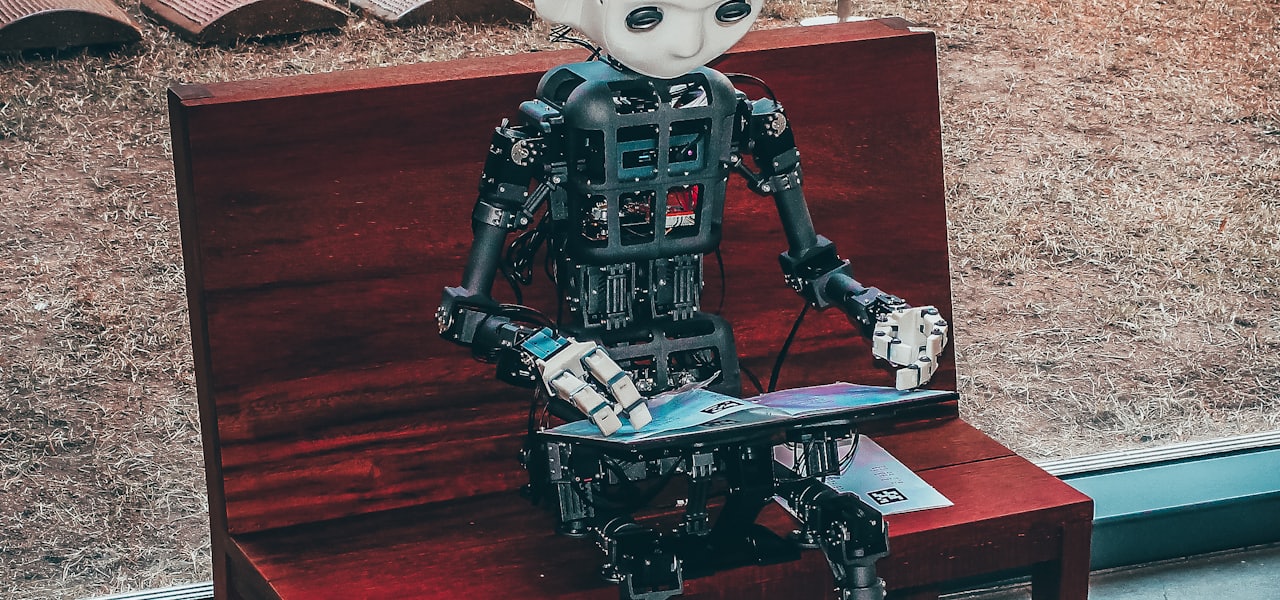
Robotics is the interdisciplinary study and practice of the design, construction, operation, and use of robots. A roboticist is someone who specializes in robotics. Robotics usually combines four aspects of design work: a power source (e.g. a battery), mechanical construction, a control system (electrical circuits), and software (run by remote control or artificial intelligence). The goal of most robotics is to design machines that can assist humans in various fields, such as agriculture, construction, domestic work, food processing, inventory management, manufacturing, medicine, military, mining, space exploration, and transportation. Robots impact humans by displacing workers. Some expect this to occur at an increasing rate, leading to proposed solutions such as basic income. Robotics is itself a lucrative business that creates careers, especially for postgraduates. Roboticists often aim to create machines that seem to interface naturally with humans. The field is under active research and development, with areas of interest including robot kinematics and quantum robotics. == Design == Robotics usually combines four aspects of design work to create a robot: Power source: Potential energy sources include wired electricity, a battery, and/or petrol. Mechanical construction: A physical form or combination of forms is designed to functionally achieve tasks within a given range of environments. This can include locomotive elements such as wheels and caterpillar tracks, as well as hydraulic limbs and manipulators (e.g. hands). Control system: Electrical circuits (utilizing components such as diodes and transistors) are used to run software, govern motor movement, and read sensors. Software: A program is how a robot decides when or how to do something. Robotic programs can be run by remote control, artificial intelligence (AI), or a hybrid of the two. AI programming is an important part of robotic navigation and human–robot interaction. === Power source === Many different types of batteries can be used as a power source. Most are lead–acid batteries, which are safe and have relatively long shelf lives but are rather heavy compared to silver–cadmium batteries, which are much smaller in volume and much more expensive. Designing a battery-powered robot needs to take into account factors such as safety, cycle lifetime, and weight. Generators, often some type of internal combustion engine, can also be used, but are often mechanically complex and inefficient. Additionally, a tether could connect the robot to a power supply, saving weight and space, but requiring a cumbersome cable. Potential power sources include: Flywheel energy storage Hydraulics Nuclear Organic garbage (through anaerobic digestion) Pneumatics (compressed gases) Solar power === Mechanical construction === Actuators are the "muscles" of a robot, the parts which convert stored energy into movement. The most popular actuators are electric motors that rotate a wheel or gear and linear actuators that control factory robots. Most robots use electric motors—often brushed and brushless DC motors in portable robots or AC motors in industrial robots and computer numerical control machines—especially in systems with lighter loads and where the predominant form of motion is rotational. Meanwhile, linear actuators move in and out and often have quicker direction changes, particularly when large forces are needed, such as with industrial robotics. They are typically powered by oil or compressed air, but can also be powered by electricity, usually via a motor and a leadscrew. The mechanical rack and pinion is common. Recent alternatives to DC motors are piezoelectric motors, including ultrasonic motors, in which tiny piezoceramic elements vibrate many thousands of times per second, causing linear or rotary motion. One type uses the vibration of the piezo elements to step the motor in a circle or a straight line; another type uses the piezo elements to vibrate a nut or drive a screw. The advantages of these motors are nanometer resolution, speed, and force for their size. Series elastic actuation (SEA) relies on introducing intentional elasticity between the motor actuator and the load for robust force control. Due to the resultant lower reflected inertia, series elastic actuation improves safety during robot interactions or collisions. Further, it provides energy efficiency and shock absorption (mechanical filtering) while reducing excessive wear on the transmission and other components. This approach has successfully been employed in various robots, particularly advanced manufacturing robots and walking humanoid robots. The controller design of a series elastic actuator is most often performed within the passivity framework as it ensures the safety of interaction with unstructured environments. However, this framework suffers from stringent limitations imposed on the controller, which may impact performance. Pneumatic artificial muscles, also known as air muscles, are special tubes that expand (typically up to 42%) when air is forced inside them; they are used in some robot applications. Muscle wire, also known as shape memory alloy, is a material that contracts (under 5%) when electricity is applied; they have been used for some small robots. Electroactive polymers are a plastic material that can contract substantially (up to 380% activation strain) from electricity and have been used in the facial muscles and arms of humanoid robots, as well as to enable new robots to float, fly, swim or walk. Additionally, elastic carbon nanotubes are a promising experimental artificial muscle technology. The absence of defects in carbon nanotubes enables these filaments to deform elastically by several percent, with energy storage levels of perhaps 10 J/cm3 for metal nanotubes. Human biceps could be replaced with wire of this material measuring 8 millimetres (3⁄8 in) in diameter, feasibly allowing future robots to outperform humans. ==== Locomotion ==== Robots with only one or two wheel(s) can have advantages such as greater efficiency, reduced parts, and navigation through confined areas. A one-wheeled robot balances on a round ball; Carnegie Mellon University's Ballbot is the approximate height and width of a person. Several attempts have also been made to build spherical robots (also known as orb bots or ball bots), which move by spinning a weight inside the ball or rotating outer shells. Two-wheeled balancing robots generally use a gyroscope to detect how much a robot is falling and drive the wheels proportionally up to hundreds of times per second to counterbalance the fall, based on inverted pendulum dynamics. NASA's Robonaut has been mounted to a Segway for a similar effect. Most mobile robots have four wheels or continuous tracks. Six wheels can give better traction in outdoor terrain, while tracks provide even more grip. Tracked wheels are common for outdoor off-road robots, but are difficult to use indoors. A small number of skating robots have been developed, one of which is a multimodal walking and skating device with four legs and unpowered wheels. Several robots have been made that can walk on two legs, but not yet as reliably as a human. Many other robots have been built that walk on more than two legs, being significantly easier. Walking robots could be used for uneven terrains, providing a high degree of mobility and efficiency, but two-legged robots can currently only handle flat floors or perhaps stairs. Some approaches have included: The zero moment point (ZMP) is the algorithm used by robots such as Honda's ASIMO. The robot's onboard computer tries to keep the total inertial forces (the combination of Earth's gravity and the acceleration and deceleration of walking) exactly opposed by the floor reaction force (the force of the floor pushing back on the robot's foot). In this way, the two forces cancel out, leaving no moment (force causing the robot to rotate and fall over). Human observers note that this is not exactly how a human walks, with some describing ASIMO's walk as looking like it needs use the bathroom. ASIMO's walking algorithm utilizes some dynamic balancing, but requires a flat surface. Several robots, built in the 1980s by Marc Raibert at the MIT Leg Laboratory, successfully demonstrated very dynamic walking. Initially, a robot with only one leg, and a very small foot could stay upright simply by hopping. The movement is the same as that of a person on a pogo stick. As the robot falls to one side, it would jump slightly in that direction to catch itself. Soon, the algorithm was generalized to two and four legs. A bipedal robot was demonstrated running and even performing somersaults. A quadruped was also demonstrated which could trot, run, pace, and bound. A more advanced approach is a dynamic balancing algorithm, which constantly monitors the robot's motion and places the feet to maintain stability. This technique has been demonstrated by Anybots' Dexter robot (
Graphics software
In computer graphics, graphics software refers to a program or collection of programs that enable a person to manipulate images or models visually on a computer. Computer graphics can be classified into two distinct categories: raster graphics and vector graphics, with further 2D and 3D variants. Many graphics programs focus exclusively on either vector or raster graphics, but there are a few that operate on both. It is simple to convert from vector graphics to raster graphics, but going the other way is harder. Some software attempts to do this. In addition to static graphics, there are animation and video editing software. Different types of software are often designed to edit different types of graphics such as video, photos, and vector-based drawings. The exact sources of graphics may vary for different tasks, but most can read and write files. Most graphics programs have the ability to import and export one or more graphics file formats, including those formats written for a particular computer graphics program. Such programs include, but are not limited to: GIMP, Adobe Photoshop, CorelDRAW, Microsoft Publisher, Picasa, etc. The use of a swatch is a palette of active colours that are selected and rearranged by the preference of the user. A swatch may be used in a program or be part of the universal palette on an operating system. It is used to change the colour of a text or image and in video editing. Vector graphics animation can be described as a series of mathematical transformations that are applied in sequence to one or more shapes in a scene. Raster graphics animation works in a similar fashion to film-based animation, where a series of still images produces the illusion of continuous movement. == History == SuperPaint was one of the earliest graphics software applications, first conceptualized in 1972 and achieving its first stable image in 1973 Fauve Matisse (later Macromedia xRes) was a pioneering program of the early 1990s, notably introducing layers in customer software. Currently Adobe Photoshop is one of the most used and best-known graphics programs in the Americas, having created more custom hardware solutions in the early 1990s, but was initially subject to various litigation. GIMP is a popular open-source alternative to Adobe Photoshop.
Layers (digital image editing)
Layers are used in digital image editing to separate different elements of an image. A layer can be compared to a transparency on which imaging effects or images are applied and placed over or under an image. Today they are an integral feature of image editors. In the early days of computing, memory was at a premium and the idea of using multi-layered images was considered infeasible in personal computer applications as the tradeoffs were image size and color depth. As the price of memory fell it became feasible to apply the concept of layering to raster images. The first software known to apply the concept of layers was LALF, which was released in 1989 for the NEC PC-9801. LALF's terminology for layers is "cells", after the concept of drawing animation frames over-top of a stencil. Layers were introduced in Western markets by Fauve Matisse (later Macromedia xRes), and then available in Adobe Photoshop 3.0, in 1994, which lead to widespread adoption. In vector image editors that support animation, layers are used to further enable manipulation along a common timeline for the animation; in SVG images, the equivalent to layers are "groups". == Layer types == There are different kinds of layers, and not all of them exist in all programs. They represent a part of a picture, either as pixels or as modification instructions. They are stacked on top of each other, and depending on the order, determine the appearance of the final picture. In graphics software, layers are the different levels at which one can place an object or image file. In the program, layers can be stacked, merged, or defined when creating a digital image. Layers can be partially obscured allowing portions of images within a layer to be hidden or shown in a translucent manner within another image. Layers can also be used to combine two or more images into a single digital image. For the purpose of editing, working with layers allows for applying changes to just one specific layer. == Layer (basic) == The standard layer available to most programs consists of a rectangular, semitransparent picture which may be superimposed over other layers. Some programs require that layers cover the same area as the final canvas, but others offer layers of multiple sizes. Each layer may bear individual settings, such as opacity, blending modes, dynamic filters, and potentially hundreds of other properties. == Layer mask == A layer mask is linked to a layer and hides part of the layer from the picture. What is painted black on the layer mask will not be visible in the final picture. What is grey will be more or less transparent depending on the shade of grey. As the layer mask can be both edited and moved around independently of both the background layer and the layer it applies to, it gives the user the ability to test a lot of different combinations of overlay. == Adjustment layer == An adjustment layer typically applies a common effect like brightness or saturation to other layers. However, as the effect is stored in a separate layer, it is easy to try it out and switch between different alternatives, without changing the original layer. In addition, an adjustment layer can easily be edited, just like a layer mask, so an effect can be applied to just part of the image.